
A professional information site that fails to name its publishing director is subject to a criminal fine. One might think that the legal notices are merely a copy-paste of a generic template, but an online media outlet has specific obligations that far exceed those of a classic showcase site. The SREN law of May 21, 2024, has indeed shifted and clarified the rules for identifying publishers, rendering many existing legal notice pages partially obsolete.
SREN Law 2024 and New Identification Obligations for Online Publishers
Before law n° 2024-449 of May 21, 2024, the identification obligations were outlined in article 6-III of the LCEN of 2004. Since this reform, they are now covered by article 1-1 of the LCEN. This shift is not just a change in numbering: the text now clarifies the distinction between publisher, publishing director, and editorial manager.
For a professional information site, this distinction has a concrete impact. It is no longer sufficient to simply state the name of the company and a contact email. It is necessary to specifically identify the person responsible for the editorial content published, according to the regime of online public communication.
It is noted that many B2B sites have not updated their notices after this reform. For discovering B2B Infos online, for example, the legal notice page already incorporates this structuring in accordance with the current text.
Publishing Director on an Information Site: A Legal Role, Not an Administrative Line
On a showcase site, the publishing director is often the manager, mentioned without anyone paying attention. On an editorial site that publishes articles, analyses, or sector news, the publishing director assumes criminal responsibility for the content disseminated. This is the regime inherited from the law of July 29, 1982 (article 93-2) that applies.
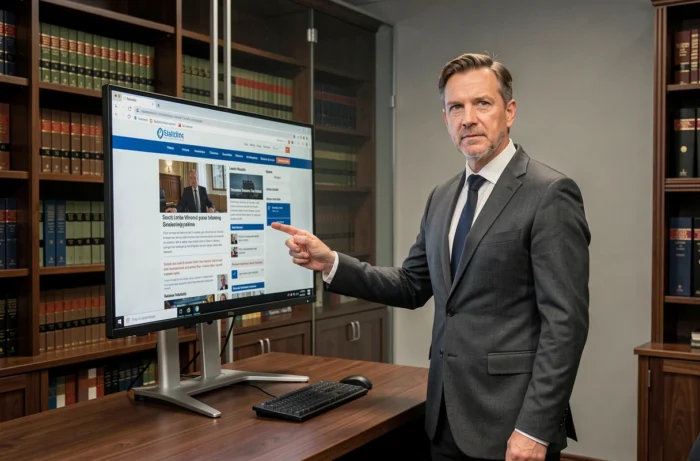
For a legal entity, the publishing director is the legal representative. For an individual publisher, it is themselves. This designation cannot be delegated to a service provider or freelance writer without legal consequences.
Editorial Manager: A Complementary Mention Not to Be Overlooked
When the site’s editorial team is distinct from the management, naming an editorial manager becomes a point of vigilance. This is particularly the case for professional media organized around an editorial team. This mention helps clarify the chain of responsibility and avoid any ambiguity in case of disputes over a published article.
In practice, an additional line is added to the legal notices with the name, first name, and position of this manager. Opinions vary on this point: some legal experts consider this mention optional as long as a publishing director is designated, while others systematically recommend it for sites with high editorial output.
Mandatory Legal Notices: What a B2B Information Site Must Display
The information to be included depends on the publisher’s status. Here is what is required for a professional site publishing editorial content:
- Full identity of the publisher: company name (or name and first name for a sole proprietorship, with the mention EI), registered office address, registration number with the RCS, VAT identification number, email address, and phone number
- Name of the publishing director and, if applicable, the co-publishing director and the editorial manager
- Identity of the site’s host: name or company name, address, and phone number
- If the activity is regulated (online press with approval, for example): name and address of the authority that issued the authorization
The absence of these mentions exposes one to a criminal sanction, not just a warning. Failure to comply with the identification obligation is punishable by a fine whose amount varies depending on the status (individual or legal entity).
Accessibility of the Legal Notices Page
The LCEN requires that this information be easily accessible. A footer link is sufficient in most cases, but it must be present on all pages of the site. A link hidden in a submenu or accessible only from the homepage does not meet this requirement.
Personal Data and Cookies on a Professional Information Site
A B2B information site collects data at several levels: contact forms, newsletter subscriptions, audience measurement cookies, advertising cookies. The GDPR fully applies, regardless of the size of the structure.
The legal notices must specify or refer to a privacy policy that details:
- The purposes of each data processing (why certain information is collected)
- The legal basis for processing (consent, legitimate interest, legal obligation)
- The recipients of the data (technical service providers, advertising agencies, partners)
- The rights of users (access, rectification, deletion, portability) and the procedure to exercise them
The CNIL has imposed several sanctions via the simplified procedure against sites that did not display a compliant cookie banner or that did not allow a refusal as simple as acceptance. A site that activates trackers before the user’s explicit consent is in violation, even if it displays a banner.

Intellectual Property: Protecting Editorial Content
For a site that produces original articles, an intellectual property clause in the legal notices reminds that texts, images, and infographics are protected by copyright. This mention does not create additional rights (protection exists by default), but it clarifies the conditions for reproduction and citation. It is generally specified that any reproduction without prior written permission is prohibited.
B2B information sites whose content is regularly reused by aggregators or competitors have an interest in drafting this clause precisely rather than settling for a vague formula.
Updating legal notices after each regulatory change remains the only guarantee of lasting compliance. The notices page is not a fixed document at the launch of the site: it follows the legal life of the company and the texts in force.