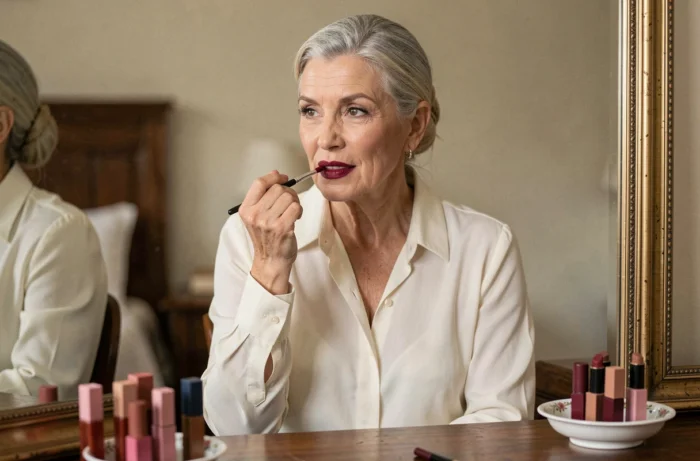
A woman applies her usual lipstick and notices that it settles into the fine lines after an hour. The product hasn’t changed, but the texture of her lips has evolved.
After 50, the skin on the lips thins, dehydrates more quickly, and some formulas that worked perfectly become unsuitable. Finding a lipstick for mature women that lasts without accentuating the wrinkles requires a review of the texture, color, and lip preparation.
Texture of lipstick after 50: the criterion that color cannot replace
We often choose a lipstick for its shade. After 50, it’s the texture that determines the final result on the lips. A formula that is too dry emphasizes every fine line, while a product that is too greasy migrates outside the contour within minutes.
Creamy formulas with a satin finish offer the best compromise. They deposit enough pigment to cover irregularities without drying out. A satin finish hydrates and lasts better than an ultra-matte finish on mature lips. Feedback confirms that the texture-hold compromise remains the central point of choice.
Long-lasting liquid matte lipsticks, very popular, pose a specific problem: their dry film pulls on the thin skin of the lips and creates a cracked effect over the hours. If one prefers matte, it is necessary to look for so-called “comfort” or “creamy” formulas, which maintain a velvety appearance without drying out.
A recent consumer review of a creamy matte lipstick describes an easy-to-apply formula that does not dry out. Not all matte textures are created equal.
For those looking for more lipstick tips for mature women, the question of texture deserves to be settled even before moving on to the color chart.

Flattering lipstick colors after 50: beyond the go-to nude
Brown-based nude is often presented as the ideal color after 50. It works, but it is not the only option, and on certain complexions, it can dull the face instead of brightening it.
Wood rose and old rose: shades that rejuvenate the smile
Shades of wood rose or old rose bring freshness without the artifice of bubblegum pink. They create the illusion of naturally colored lips, softening the facial features. On light to medium skin, these shades warm the complexion without overpowering the lips.
Warm nude and sienna: for medium to dark skin
On medium or dark skin, a nude that is too light creates an unflattering washed-out effect. It is better to choose warm nude shades, leaning towards sienna or caramel. The goal is to stay within the natural range of one’s complexion, one to two tones above the color of bare lips.
Colors to handle with care
- Classic bright red can work, but only with a well-matched lip liner and precise application, to prevent it from migrating and accentuating the fine lines around the mouth.
- Bordeaux and purple can define the features and may give a severe effect on a mature face, especially in natural light.
- Very pale or frosted shades flatten the relief of the lips and visually amplify the loss of volume.
Testing the color on the lip, not on the hand remains the most reliable method. Lip pigmentation varies from person to person, and a flattering nude for one complexion may appear dull on another.
Preparing and defining mature lips: the steps that change the hold
Applying lipstick directly on dry lips after 50 compromises the hold and appearance from the start. A few preparation steps make a real difference.
- Moisturize the lips with a fragrance-free balm at least ten minutes before application. Well-hydrated lips hold pigment better and limit the cracked effect.
- Outline with a lip pencil in the same shade as the chosen lipstick (or slightly lighter). The pencil creates a waxy barrier that prevents the color from migrating into the fine lines.
- Applying lipstick with a brush rather than a bullet allows for a finer and more even application, reducing the risk of accumulation in the creases.
- Blotting with a tissue between two thin layers provides better adhesion than a single thick layer.
Feedback varies on the usefulness of a specific lip primer. Some women find that it prolongs wear, while others notice a drying effect. The most reliable alternative remains the duo of moisturizing balm followed by lip liner.
INCI list and allergens: a reflex to adopt for reactive lips
After 50, lips often become drier and more reactive to fragrances and preservatives. New cosmetic products on the market must comply with the enhanced requirements for labeling fragrance allergens starting July 31, 2026, with some existing stocks still being sold until July 31, 2028.
In practical terms, this means that checking the INCI list before buying lipstick will become easier: fragrance allergens will be identified in more detail on the packaging. In case of lips that sting, redden, or peel after application, opting for fragrance-free formulas significantly reduces the risk of reaction.
The European regulation (EU) 2023/2055 also provides for a transition period for certain microplastics added to cosmetics, particularly shiny particles. Lipsticks with pearlescent or glitter effects will not disappear immediately, but preferring formulas without synthetic glitter is both a dermatological and environmental choice for mature lips.
Lipstick after 50 is not a question of giving up. One retains the right to color, finish, and intensity. The filter to apply is primarily texture, then shade, and always lip preparation. The lip liner and fragrance-free balm are the two most underestimated allies of successful lip makeup at this age.