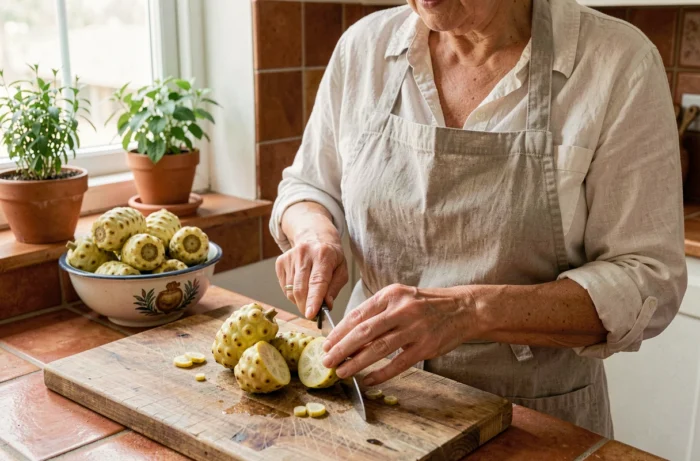
Noni (Morinda citrifolia) produces a juice with a very particular sensory profile: a pungent smell, a pronounced bitter taste, and a texture that varies depending on the ripeness of the fruit. These characteristics influence every stage of the transformation, from the selection of the fruit to the final filtration. Understanding what happens chemically during fermentation or blending allows for a drinkable result, and not just a liquid technically referred to as “juice”.
Sensory profile of noni and impact on the preparation method
The technical documentation on noni, particularly that from the Qualireg network, emphasizes that volatile fatty acids are responsible for the unpleasant aroma of the fruit. Octanoic acid and hexanoic acid dominate this unpleasant olfactory profile, often described as a “goaty” smell.
This point changes the game for homemade preparation. Most recipes simply involve blending and filtering, without mentioning that the stage of ripeness of the fruit directly alters the concentration of these compounds. A fruit at the “translucent white” stage (just ripe) produces a juice that is significantly less acrid than a fruit that has turned brown after several weeks of storage.
The preparation of noni juice benefits from incorporating this information from the start: selecting the fruit at the right stage of ripeness greatly reduces the need to mask the bitterness with other juices.
| Ripeness Stage | Fruit Color | Impact on Juice |
|---|---|---|
| Immature | Green | Little juice, very bitter, difficult to extract |
| Ripe (optimal) | Translucent white | Lighter juice, less acrid aroma, good yield |
| Overripe (1-3 weeks) | Light brown | Strong smell, beginning of natural fermentation |
| Very advanced (7-8 weeks) | Black brown | Advanced fermentation, very pronounced taste |
This table summarizes the stages described in the literature on Morinda citrifolia. For pleasant consumption, the translucent white stage offers the best taste-yield compromise.
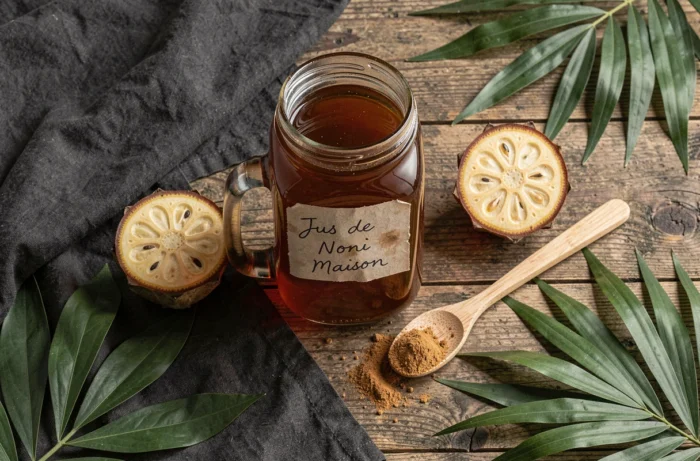
Traditional fermentation of noni or quick extraction with a blender
Two methods coexist and produce very different results, both in terms of taste and preservation.
Sun fermentation method
The traditional Polynesian technique involves filling a glass container with whole ripe fruits and letting them ferment in the sun for about two months. The juice flows naturally as the fruits decompose.
- The container must be clean but not airtight: fermentation produces gases that must be able to escape, or else the container may burst
- The fruit is not cut or peeled; it is placed whole in the jar, which slows down extraction but promotes slow fermentation
- The juice obtained after filtration is cloudy, strongly aromatic, and can be stored in the refrigerator for several months thanks to the acidity developed during fermentation
Fermentation produces a more concentrated but also more aromatic juice than mechanical extraction. This is the historical method, the one that gives the “true” noni in the traditional sense of the term.
Quick extraction with a blender
To obtain juice in a few minutes, the ripe fruit is peeled, cut into pieces, and then blended with a little water. The mixture is then filtered through a fine sieve or cheesecloth.
The result is less concentrated and does not keep as long (a few days in the refrigerator). However, the aroma remains more subtle as fermentation has not had time to release as many volatile fatty acids.
Filtration of noni juice and reduction of bitterness
Filtration is the most underestimated step in consumer recipes. Passing the juice through a coarse strainer leaves pulp particles that enhance bitterness and accelerate degradation.
The industrial process described by Cirad and Qualireg uses tangential microfiltration to eliminate the volatile fatty acids responsible for the odor without altering the antioxidant power or polyphenol content of the fruit. At home, this technology is not accessible, but double filtration (sieve then fine cheesecloth) significantly improves clarity and taste.
Specifically, after the first pass through the sieve, letting the juice rest for an hour in the refrigerator allows heavy particles to settle. Filtering a second time through a tight fabric (like cheesecloth) produces a clearer juice that is significantly less acrid.

Storage and mixing with other fruits for daily consumption
Pure noni juice is rarely consumed as is, even by devoted fans. Its taste profile integrates better into a blend.
- Grape or apple juice effectively masks the bitterness while preserving the compounds of noni
- Vanilla (infused pod or natural extract) softens the perception of the pungent smell without adding acidity
- A blend with fresh pineapple works well due to the natural acidity of this fruit, which balances the noni profile
Noni keeps better when pure, then is mixed at the time of consumption. Preparing a large volume of mix in advance accelerates degradation, as the sugars from other fruits promote bacterial proliferation.
For fermented juice, a glass jar in the refrigerator is sufficient. For blended juice, consumption within three to four days remains the rule. Some enthusiasts freeze the juice in individual portions in ice cube trays, which works for integration into a daily smoothie.
The choice between fermentation and quick extraction ultimately depends on two parameters: tolerance to smell and available time. Traditional fermentation yields a richer and more stable product, but the process takes several weeks and the aroma can become overwhelming in a living space. Blender extraction, which is quicker, is better suited for occasional consumption or for a first experience with the fruit.