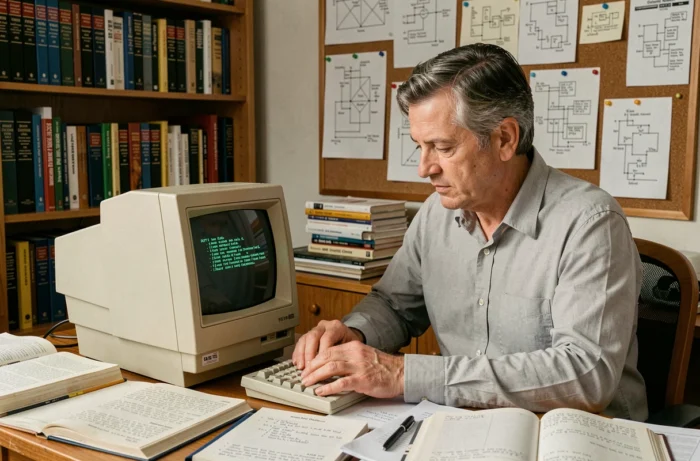
When deploying an information system in a small or medium-sized enterprise or updating a fleet of workstations, one manipulates software and hardware layers built upon more than a century of evolution. Understanding computing is not just about knowing the latest trendy framework: it’s about knowing why a computer works the way it does, and what changes in how we are allowed to use it.
Four concepts that drive any computer system
Before discussing history or trends, it’s more efficient to lay down the basic building blocks. Every computing machine, from the data center server to the smartphone, relies on four operational concepts that have not changed since their formalization.
- The algorithm is a finite sequence of instructions that transforms an input into an output. It is the assembly plan that the processor follows, regardless of the programming language used.
- Information, in computing terms, is a set of data encoded in binary. A text file, an image, a video stream: everything boils down to sequences of 0s and 1s that the machine stores and processes.
- The programming language translates human logic into instructions understandable by the machine. From C to Python, each language imposes its syntax constraints and preferred usages.
- The operating system orchestrates access to hardware (memory, processor, input-output) and allows programs to coexist without conflict.
In practice, when a program crashes or a calculation takes too long, it almost always traces back to one of these four levels. Understanding computing on Wiki Dark allows for a deeper exploration of each of these layers with structured resources.

From mechanical calculation to the transistor: hardware breakthroughs in computing
Competitors are eager to present a year-by-year timeline. Instead, we will isolate the two hardware shifts that fundamentally change the game when working with machines.
The shift from mechanical to electronic
The first calculating machines (Blaise Pascal’s Pascaline, the analytical machine envisioned by Charles Babbage) operated with gears and punched cards. The limit was physical: the more complex the calculation, the bulkier and slower the mechanism.
The arrival of vacuum tubes during World War II allowed for data processing at unprecedented speeds. Electronic calculation made recorded programming possible, meaning the ability to store instructions in the machine’s memory itself, rather than physically rewiring circuits for each operation.
The transistor and then the integrated circuit
The transistor replaced the vacuum tube: smaller, more reliable, and less energy-consuming. A few years later, the integrated circuit grouped thousands and then millions of transistors on a chip. This miniaturization paved the way for the personal microcomputer in the 1970s and 1980s, and then for the portable devices we use daily.
In practice, each leap in miniaturization has halved the cost of computation and broadened the audience. A computer that occupied an entire room in the 1950s now fits in a pocket.
Network, web, and cloud: when the computer ceases to be isolated
The second major shift is not hardware but architectural. As long as a computer worked alone, its power remained local. Networking changed everything.
The TCP/IP protocol, the technical foundation of the Internet, standardized communication between heterogeneous machines. The web, an application layer that emerged in the early 1990s, made this interconnection accessible to non-specialists through the browser and hyperlinks.
Cloud computing has moved computing power outside the enterprise. Instead of buying and maintaining servers, one rents capacity on demand. For a field team, this means that a technician can access a business application from any site, as long as there is a proper network connection.
Feedback varies on this point depending on local coverage, but the principle remains the same: the workstation becomes a terminal, the power is elsewhere.
AI Act and regulation by risk level: what changes for computer systems
There is much talk about artificial intelligence, but less about the legal framework that now applies to the systems that use it. The European regulation 2024/1689, known as the AI Act, came into effect on August 1, 2024. It introduces a new framework: a computer system is classified according to the risk it poses to security, health, and fundamental rights, rather than the technology it incorporates.
Four risk levels to know
- Unacceptable risk: the system is prohibited (generalized social scoring, subliminal manipulation).
- High risk: the system is allowed under strict conditions of documentation, human oversight, and compliance (automated recruitment, medical devices).
- Limited risk: transparency obligations apply (chatbots, deepfakes).
- Minimal or no risk: no specific constraints (spam filters, video games).
In practice, the same cloud infrastructure or analytical tool can shift from one category to another depending on its use. For a team deploying an HR management software that incorporates AI, the question is no longer “what algorithm are we using?” but “what impact does this system have on the people involved?”.
Regulation by usage risk transforms IT governance by imposing an upfront assessment, even before production deployment. This marks a turning point from previous decades where regulation primarily aimed at protecting personal data (GDPR) without qualifying the danger of the processing itself.
Computing, from the abacus to regulated cloud, remains a discipline where each technical layer inherits from the previous one. What has radically changed since 2024 is that the law no longer only looks at what the machine does, but what its use can provoke. For any organization that operates digital systems, integrating this risk logic from the design stage is no longer an option.