
The online jewelry market attracts a growing number of buyers each year. This accessibility is accompanied by an increasing volume of fraud. Between ephemeral sites, fake reviews, and poorly identified metals, the traps have become more sophisticated. Buying jewelry online without falling into scams requires knowing how to read what a site shows, but also what it hides.
Mandatory withdrawal button: a quick compliance test for jewelry sites
Since June 19, 2026, every online sales site must offer a free, visible, and directly accessible feature allowing consumers to exercise their right of withdrawal. The wording must be explicit, such as “withdraw from the contract here.”
For a jewelry buyer, this requirement becomes a first-level filter. A site that does not offer this button, or that requires sending a registered letter without a digital alternative, does not comply with the legal framework of French e-commerce. This shortcoming signals a broader risk regarding the seller’s reliability.
Before looking at the collections, check for the presence of this online withdrawal process. If you have to dig through the terms and conditions to find a postal address as the only return option, move on. The tips from La Fantaisie net remind us that the transparency of return conditions remains one of the most reliable indicators to distinguish a serious seller from a dubious site.
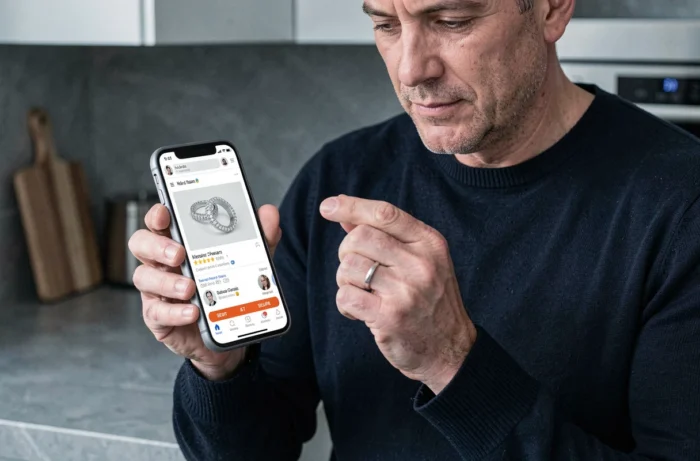
Customer reviews on online jewelry stores: a reliability to put into perspective
Reviews often constitute the first reflex before a purchase. For a ring or a necklace, where perceived quality heavily depends on photos and descriptions, comments from other buyers seem reassuring. The reality is more nuanced.
The DGCCRF published a report on 397 establishments checked regarding online reviews. Nearly one third showed anomalies: manipulated, unverified, or misleadingly presented reviews. The jewelry sector, where margins are high and competition fierce, is not exempt from these practices.
What review platforms do not always filter
A site can display a flattering rating on Trustpilot or Google while having solicited reviews in exchange for discounts, deleted negative feedback, or published fake testimonials. The way the seller responds to negative critiques sometimes provides more information than the overall rating.
Here are some signals to spot before trusting the reviews of an online jewelry store:
- Very short reviews, all published over a tight timeframe, with similar vocabulary, suggest an organized campaign rather than spontaneous feedback.
- The complete absence of negative reviews among a large volume of comments is statistically improbable and should raise alarms.
- A seller who publicly responds to critiques by offering concrete solutions (returns, refunds, exchanges) demonstrates a real functioning after-sales service.
Hallmarks and certificates of authenticity: reading what the jewelry carries
The question of materials remains the blind spot of many online purchases. A piece of jewelry described as “gold-plated” or “925 silver” is not necessarily so. The legal hallmark remains the only physical guarantee of the metal used.
In France, precious metals (gold, silver, platinum) must bear a guarantee hallmark affixed by a guarantee office or an approved control organization. This hallmark certifies the metal’s title. A piece sold as 750 thousandths gold without a visible hallmark in high-resolution photos, or without explicit mention in the product sheet, raises an authenticity issue.
What a serious product sheet should mention
Beyond the hallmark, a reliable seller details the weight in grams, the metal’s title, and for stones, their exact nature (natural, synthetic, treated). The absence of these technical details is a more reliable warning signal than the price.
The most common scams do not involve costume jewelry sold as such, but rather pieces described with deliberately ambiguous vocabulary. “Gold style,” “silver color,” “diamond type”: these formulations circumvent description obligations without lying outright.
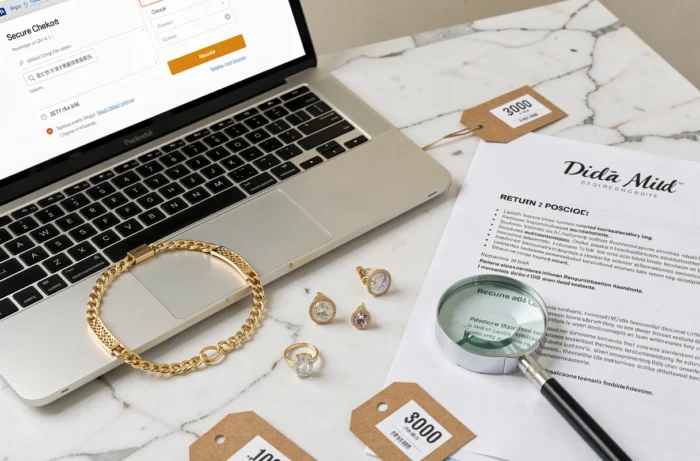
Strikethrough prices and false promotions on jewelry: tightened regulatory framework
Permanent promotions are a tried-and-true technique to create a sense of urgency. A necklace displayed at 29 euros “instead of 89 euros” all year round does not represent a real discount.
French regulations require that the strikethrough price corresponds to the lowest price practiced in the 30 days preceding the promotion. This rule, stemming from the European Omnibus directive, applies to all online sales sites. A seller who displays a discount of more than 50% continuously exposes themselves to sanctions, and the DGCCRF has already conducted targeted inspections in this area.
For the buyer, verification is simple: compare the price of the jewelry over several weeks, using price tracking tools or screenshots. If the “promotional” price never changes, the discount is not real.
Scams involving influencer partnerships and fake ambassadors
Another fraudulent sales lever concerns fake partnerships with influencers. Some sites create entirely fictitious collaborations, using photos or names of content creators without their consent. These setups aim to legitimize an offer that does not withstand scrutiny.
Before purchasing jewelry promoted by an influencer, check that the publication actually exists on the relevant account. A legitimate partnership is always identified by the mention “advertisement” or “commercial collaboration”.
Buying jewelry online relies on careful reading of scattered signals: legal compliance of the site, quality of product sheets, consistency of reviews, reality of promotions. None of these criteria taken in isolation is sufficient, but their accumulation draws a fairly clear line between reliable sellers and sites to avoid.