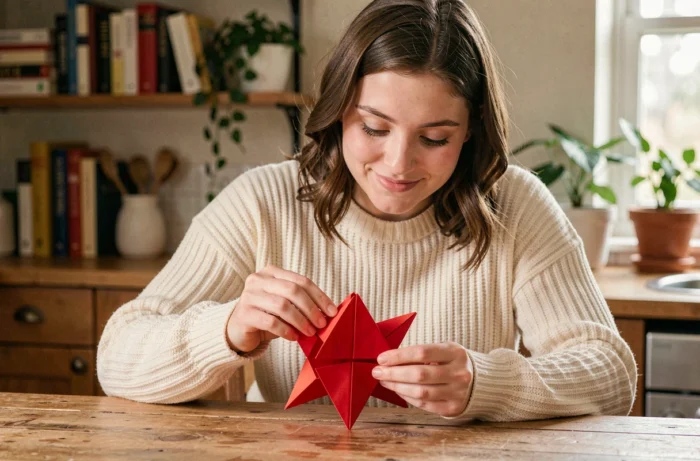
The paper fortune teller works on a simple principle: you fold, manipulate it with your fingers, and discover a hidden message. The pleasure comes as much from the folding as from the surprise of what is written inside. However, once the paper is unfolded in front of you, pen in hand, it’s often a blank slate. Eight small boxes to fill, and no inspiration.
This blockage comes from a reflex: we try to write “funny” sentences without knowing for whom or in what context. Changing the approach transforms the fortune teller into a real tool for play, learning, or even family discussion.
Thematic paper fortune teller: choose a guiding thread before writing
Most fortune tellers remain vague because we mix everything: a challenge, a joke, a question, a compliment. As a result, no box is truly surprising. The most effective method is to choose a unique theme for each fortune teller.
A theme is a constraint. And this constraint frees creativity. Are you making a “animals” fortune teller? Each box contains a challenge related to animals (imitate a sound, guess a footprint, mimic a walk). Opting for a “compliments” fortune teller? Each message highlights a trait of the person playing.
When wondering what to write in a paper fortune teller, a unique theme solves half the problem: it provides a framework, and ideas come through association.
Here are some themes that work particularly well depending on age and context:
- “Emotions” fortune teller: each box asks a self-reflection question (“What made you proud this week?”, “Tell about a moment when you helped someone”). This format has been used since 2023-2024 in socio-emotional skills programs in class, as a support for guided discussion among students.
- “Physical challenges” fortune teller: each box proposes a mini physical challenge (balance on one foot while the other player counts, do a roll, touch your toes without bending your knees).
- “Imaginary travel” fortune teller: each box describes a fictional place and asks what you would do there (“You arrive on an island where the trees are made of candy. What do you eat first?”).
- “Riddles” fortune teller: one riddle per box, the answer written under the next flap.
Phrase ideas for paper fortune tellers by age
A fortune teller intended for a four-year-old does not work with the same phrases as one for a group of teenagers. A common mistake is to aim for universal humor, which ends up not making anyone laugh.
For preschool children
At this age, children cannot read yet. Fortune tellers work better with drawings or very short instructions read by an adult. Favor concrete actions: “Make the sound of a lion,” “Jump three times,” “Show your best silly face.”
Short phrases based on action verbs work better than abstract questions. “What do you feel?” will not resonate with a three-year-old. “Give a hug to the person on your right,” will.
For children aged six to ten
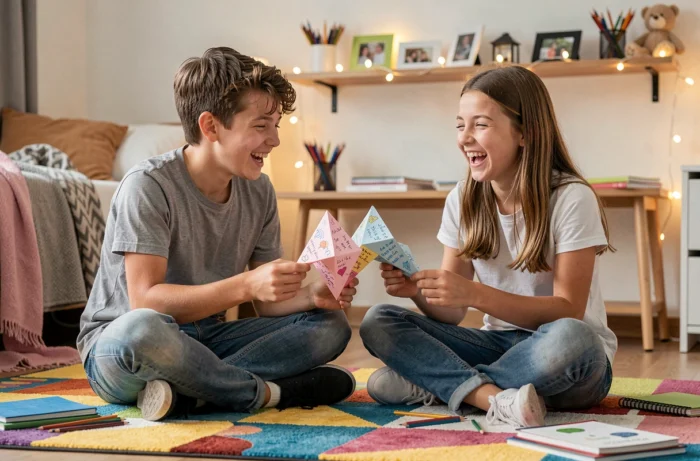
This is the age group where the paper fortune teller reaches its peak popularity. Children can read, fold, and manipulate it on their own. You can write fun challenges (“Talk like a robot for a minute”), general knowledge questions (“How many legs does a spider have?”) or micro-stories to complete (“A dragon enters the cafeteria and asks…”).
For teens and adults
The fortune teller becomes interesting again when we repurpose it. At parties, it can serve as an icebreaker with light personal questions: “What is your most embarrassing middle school memory?”, “If you could have dinner with a famous person, who would it be?”. The origami folding takes the pressure off the question, and the answer comes more naturally than in a typical roundtable.
Paper fortune teller for learning: revise with origami folding
In recent years, teachers have been using the fortune teller as a revision tool in class. The principle is straightforward: replace the challenges with course questions, and the physical manipulation of folding makes memorization more active than simple reading of notes.
A revision fortune teller contains a question on the outer flap and the answer under the inner flap. The child plays with a classmate or a parent. They choose a number, manipulate the fortune teller, read the question, attempt to answer, then check.
This format works for multiplication tables, vocabulary in a foreign language, dates in history, or capitals in geography. The playful repetition, fortune teller after fortune teller, anchors the information without the fatigue of a written exercise.
To go further, one can create multiple fortune tellers per subject with increasing levels of difficulty. The child starts with the “easy” fortune teller and moves on to the next one when they master all the answers.
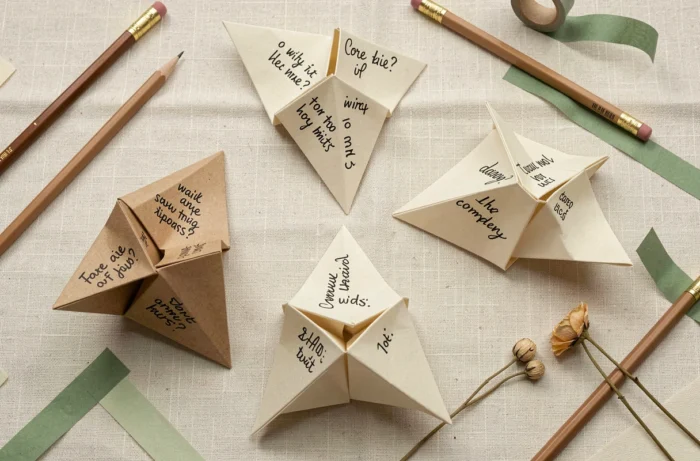
Emotion and well-being fortune teller: writing messages that open discussion
Have you noticed that a child talks more easily about their emotions when the question comes through play rather than a direct “How are you?” question? The paper fortune teller creates this natural mediation.
Recent educational resources, particularly within socio-emotional skills programs in elementary and middle school, document the use of the fortune teller as a support for guided discussion on emotions, regulation, and empathy. The activity goes beyond mere chance play: each box becomes a starting point for exchange.
Here are some examples of phrases suited to this format:
- “Share what made you laugh today.”
- “What would you like to dream about tonight?”
- “What would you do to comfort a sad friend?”
- “Name three things that make you happy right now.”
- “If you could change one thing about your day, what would it be?”
This type of fortune teller fits into an evening ritual, replacing the usual negotiations before bedtime. The origami folding transforms a sometimes tense moment into a calm exchange.
The paper fortune teller doesn’t need spectacular content to work. A good theme, age-appropriate phrases, and a clear usage are enough. Eight well-filled boxes are better than fifty random ideas on a list. The real pleasure remains the same as it was thirty years ago: sliding your thumbs and index fingers into the folds, counting, lifting the flap, and discovering what’s hidden inside.