
What documents are actually required to get married at the town hall, and how long does the process take depending on the municipalities? The deadlines and required documents vary more than one might think, especially for binational couples or individuals under international protection. This article details the steps for the civil marriage file, the differences in deadlines between municipalities, and the specific cases that complicate the procedure.
Deadlines for preparing the marriage file: what varies from one municipality to another
Submitting the marriage file at the town hall does not follow a single schedule. Some municipalities accept files several months before the desired date, while others impose a strict time frame.
| Criterion | Small municipality (less than 10,000 inhabitants) | Large city |
|---|---|---|
| Recommended deadline for submitting the file | A few weeks to two months before | Several months before (sometimes more than six months) |
| Preliminary hearing of the future spouses | Not systematic | Frequent, especially for binational couples |
| Publication of the banns | At least ten days before the ceremony | At least ten days before the ceremony |
| Availability of slots (Saturday) | Generally flexible | Limited slots, advance booking necessary |
The publication of the banns remains mandatory in all cases: it lasts at least ten days before the celebration. This non-negotiable period adds to the time taken to process the file by the civil status officer.
The future spouses must appear together when submitting the file. When the procedures for a marriage at the town hall involve two different municipalities (the residence of each spouse), the banns are published in both town halls, which extends the timeline.
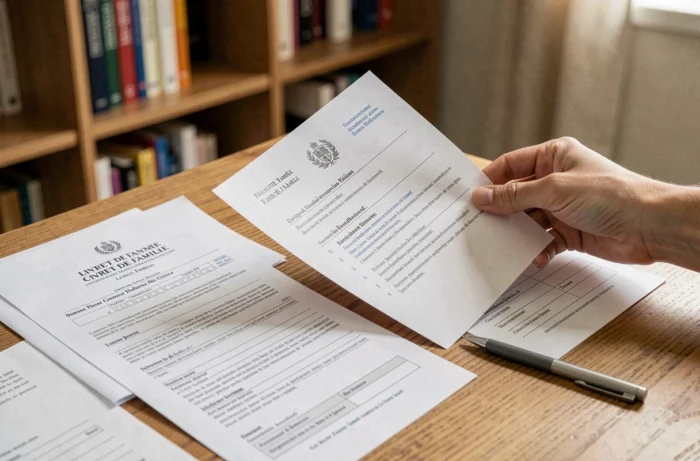
Documents for the civil marriage file: complete list and common pitfalls
The file includes a common set of documents, but additional requirements depend on the personal situation of each future spouse.
Documents systematically requested
- A birth certificate with parentage, dated less than three months for individuals born in France (less than six months for those born abroad)
- A valid identity document (national identity card or passport)
- Proof of residence or domicile in the municipality
- The list of witnesses (at least two, maximum four) with their names, first names, dates and places of birth, professions, and addresses
Common mistakes regarding the birth certificate
The primary reason for rejecting a file is an expired or incomplete birth certificate. An extract without parentage is not sufficient: the full copy or the extract with parentage are the only accepted formats.
For individuals born abroad, the certificate must be translated by a sworn translator and, depending on the country of origin, apostilled or legalized. This process can sometimes take several weeks.
Civil marriage and foreign spouses: certificate of custom and residence regularity
Binational couples face additional documentary requirements that vary depending on the status of the foreign future spouse.
The certificate of custom, issued by the consulate of the country of origin, certifies that the person is free to marry according to their national law. Refugees, stateless persons, and beneficiaries of subsidiary protection have been exempt from this requirement since February 2023. The Ofpra no longer issues them. Instead, these individuals provide a birth certificate extract with parentage dated less than six months issued by the Ofpra, which serves as a civil status document.
A recurring point of friction concerns residence regularity. Some town halls require a residence permit from the foreign future spouse. Residence regularity is not a condition for the validity of marriage under French law. The civil status officer cannot refuse to celebrate a union on the grounds that one of the spouses is in an irregular situation.

Preliminary hearing and opposition to marriage: two little-known mechanisms
The civil status officer may summon the future spouses for an individual or joint interview. This hearing aims to verify the free consent of each and to detect sham marriages.
The interview is not mandatory in all situations, but it becomes almost systematic when there is a significant age difference between the spouses or when one of them is of foreign nationality. In case of serious doubt, the mayor may refer the matter to the public prosecutor, who then has fifteen days to oppose the marriage or authorize its celebration.
Opposition to marriage can also come from a family member. Ascendants (parents, grandparents) can oppose without needing to justify their action beyond a certain point, while collateral relatives (siblings) must invoke a specific legal impediment (bigamy, prohibited kinship).
Marriage contract and matrimonial regime: the meeting with the notary before the town hall
Without a marriage contract signed before the ceremony, the couple is automatically subject to the legal regime of community property. All property acquired during the marriage becomes common, except for property received by donation or inheritance.
The meeting with the notary to choose another regime (separation of property, universal community, participation in acquisitions) must take place before the celebration. The notary issues a certificate that the future spouses attach to the marriage file at the town hall.
This choice has direct consequences on the management of the couple’s assets, the debts incurred by one of the spouses, and the transmission in case of death. The matrimonial regime can only be modified after two years of marriage, through a new notarial procedure.
The civil marriage file thus has ramifications that go beyond the simple collection of administrative documents. The deadlines for publishing the banns, the specific requirements for foreign spouses, and the choice of matrimonial regime are the three points where couples lose the most time. Anticipating these steps by several months remains the most reliable way to avoid a date postponement.