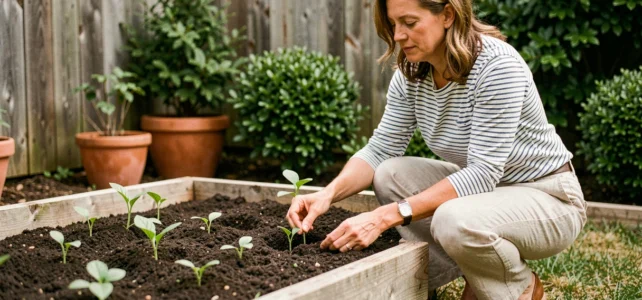
Designing an outdoor garden starts with balancing the soil available and the intended use. The type of terrain (clay, sandy, limestone), the orientation to the sun, and the budget influence every decision, from the choice of plants to the layout of pathways. Before considering decoration or furniture, these technical parameters need to be established.
Soil and exposure: the diagnosis that guides the entire garden layout
Most outdoor design errors stem from a rushed or absent soil diagnosis. Observing the ground after heavy rain provides a reliable indication: stagnant water signals clayey and compact soil, while water that disappears in a few minutes reveals well-draining, often sandy soil.
Solar exposure varies across different areas of the garden. Identifying parts that receive direct sunlight in the morning, afternoon, or almost never allows for the creation of functional zones suited to the available light. A terrace facing directly west will be pleasant in the evening but overheated in the summer without plant protection or a pergola.
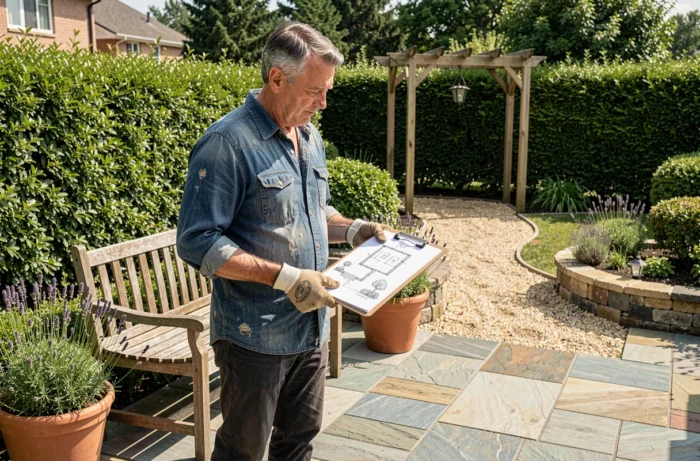
Mapping these elements on a simple sketch, even freehand, prevents planting a fruit tree in the shade of a north wall or laying grass on overly draining soil that will turn yellow by June. This preliminary work also guides material choices: a composite wood terrace on poorly draining soil requires a system of raised joists, while a natural stone slab better supports residual moisture.
To delve deeper into this step and find configurations suited to each type of terrain, the layout on Tradition Jardin offers concrete solutions that take these technical constraints into account.
Dry garden, flower meadow, or contemporary: choosing a style suited to your terrain
In recent years, three styles have dominated design requests in France: the ecological garden, the contemporary garden, and the dry garden. The latter has seen notable growth, driven by watering restrictions and the desire to reduce maintenance without sacrificing aesthetics.
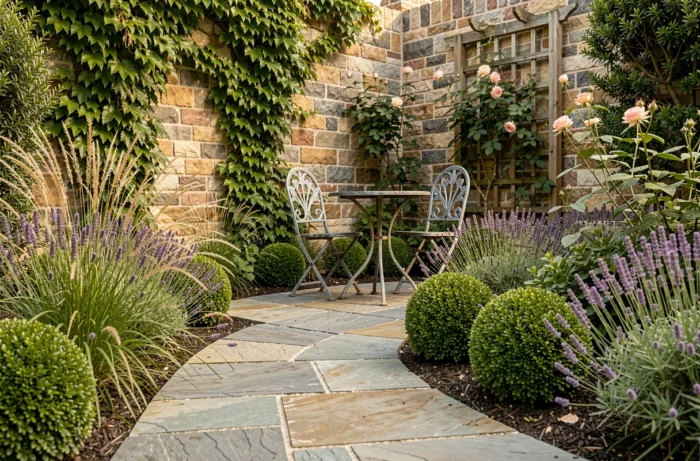
The dry garden relies on Mediterranean plants or drought-resistant grasses, combined with minerals (gravel, pebbles, dry stone). It naturally establishes itself on well-draining limestone soil. On clay soil, amendments are needed to prevent root asphyxiation, which increases the initial budget.
The flower meadow, described as the signature of the natural garden, offers an alternative for large areas. It reduces mowing to one or two cuts per year and promotes biodiversity. However, it requires precise seeding, tailored to the soil’s pH, and a first season of patience before achieving a visually satisfying result.
The contemporary garden, on the other hand, focuses on geometric lines, refined materials (polished concrete, metal, wood), and a limited plant palette. It suits modestly sized spaces where every square meter counts. Choosing a style does not preclude mixing, but a clear guiding thread avoids a catalog effect that disperses the eye.
Structuring the outdoor space with permanent elements
The trend observed since the mid-2020s is to treat the garden as a room in its own right. Built-in benches, planters made of concrete or corten steel, and low walls are gradually replacing movable furniture to create fixed visual markers.
This structured approach changes the way garden zones are conceived. Three permanent elements effectively structure an outdoor space:
- Ground levels (raised terraces, steps, embankments retained by low walls) rhythm a flat terrain and create perspectives even on a small plot.
- Vertical structures (pergolas, screens, trellises) serve as privacy screens, supports for climbing plants, and delimitations between dining and relaxation areas.
- Outdoor lighting integrated from the design stage (recessed lights, posts along a pathway, garlands fixed on a pergola) extends the use of the garden in the evening and secures pathways.
Installing these elements first, before planting, allows for working on access and networks (irrigation, electricity) without damaging the plants already in place.
Choosing plants and realistic maintenance of the outdoor garden
Selecting plants suited to the local climate and soil type drastically reduces maintenance time. A poorly placed tree that grows too quickly or whose roots lift a terrace incurs costs and work far exceeding the savings made at purchase.
For trees, considering the adult size and the regulatory distance from fences is often overlooked. A tree planted too close to a property line can become a source of conflict and forced pruning.
In terms of irrigation, a programmable drip system uses significantly less water than manual hose watering and ensures a consistency that plants appreciate, especially during the first years of establishment. Pairing this system with sufficiently thick organic mulch limits evaporation and nourishes the soil as it decomposes.
A garden that requires less than two hours of weekly maintenance is not a bargain garden. It is a garden where the choice of plants, mulching, and irrigation system have been thoughtfully considered together from the start.
Planning errors pay off over several seasons. Taking the time for the initial diagnosis, choosing a style consistent with the terrain, and installing permanent structures before planting: these three steps, in this order, make the difference between an outdoor space that ages well and a garden that ends up being neglected.