
When a printed circuit board manufacturer receives a revised soldering quote that has increased for the third time in six months, the question of the tin price ceases to be a trader’s topic. It becomes a concrete budget item. On the London Metal Exchange (LME), tin is currently trading around $55,000 per ton, a level that redefines margin calculations for the entire electronics chain.
Tin Driven by AI-Related Demand
Most market analyses explain the rise in tin prices due to supply constraints, particularly in Indonesia. This is true, but incomplete. Since the beginning of 2026, the connection of tin to AI investments has increasingly weighed on price expectations.
Tin is the base metal for precision soldering in semiconductors and data center servers. With the explosion in orders for chips dedicated to AI computing, industry players estimate that demand for tin in AI servers could triple by 2030. It is no longer an ordinary industrial metal; it is a proxy listed on the AI theme.
StoneX notes that recent gains have outpaced physical fundamentals, driven by this technological narrative. Tracking the tin price in euros allows for measuring this gap between real tension on the metal and speculative premium related to the tech sector.
Tin Performance Against Other Base Metals in 2026
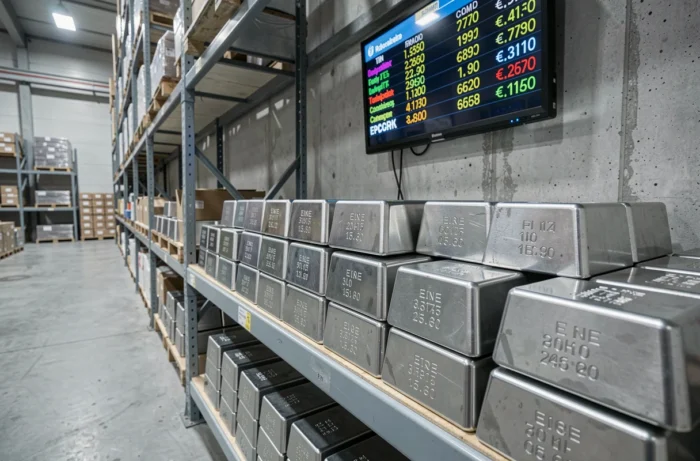
We often talk about copper or aluminum when it comes to industrial metals. In 2026, it is tin that dominates the rankings. According to Lion Rock Resources, the price has increased by about 70% year-on-year, placing tin in the range of $50,000 to $55,000 per ton.
StoneX confirms the status of tin as the top performer among base metals: in the second quarter of 2026, tin showed a 9% increase for the quarter and more than 25% since the beginning of the year. On June 2, 2026, the price reached a nominal record of $57,960 per ton on the LME.
For a European buyer, the conversion to euros adds a variable. The EUR/USD exchange rate amplifies or dampens movements in the London market. Over the past six months, the increase in euros has been slightly more pronounced than that in dollars, which directly penalizes manufacturers in the eurozone.
LME Stocks and Tensions on Indonesian Tin Supply
Price quotes do not tell the whole story. The structure of the physical market tells another, more tense story. Tin stocks on the LME experienced a phase of replenishment followed by a sharp decline in 2026. This yo-yo movement has a direct impact on the futures price curve.
On the supply side, Indonesia (the world’s largest exporter) has tightened its conditions:
- Jakarta has reduced the issuance of export licenses, limiting the volumes available on the international market.
- Mining permits have been strengthened, with increased controls on artisanal operations.
- Authorities have seized about 500 tons of metal from unlicensed mines, removing physical stock from the circuit.
Indonesian supply remains structurally constrained, and no signs of regulatory easing appear in the short term. For buyers negotiating forward delivery contracts, this situation makes price forecasting particularly tricky.

Contango, Backwardation: Reading the Tin Futures Curve
In the realm of industrial purchases, one does not only look at the spot price. The shape of the forward curve determines the actual procurement cost over three, six, or twelve months.
When LME stocks decline, the market often enters backwardation: the spot price exceeds the futures price. This is a signal of immediate physical tension. Conversely, a moderate contango (futures price slightly above the spot) indicates a better-supplied market.
In 2026, the tin curve oscillated between these two configurations. Backwardation phases coincided with Indonesian seizures and declines in LME stocks. For a buyer hedging their price risk, the choice between a spot contract and a futures contract is not trivial: a few weeks of delay can represent several hundred dollars per ton.
Tin Price Forecasts and Factors to Watch
Trading Economics’ macroeconomic models anticipate a price around $56,000 per ton by the end of the current quarter, with a projection of about $63,000 in twelve months. Other analysts mention a target of $62,000 by the end of 2026, contingent on the continuation of the destocking trend.
Several concrete factors deserve regular monitoring:
- Jakarta’s decisions on export quotas, which can tighten supply overnight.
- Quarterly results from chip manufacturers (Nvidia, Samsung, SK Hynix), whose order books directly influence anticipated solder demand.
- The evolution of the EUR/USD exchange rate, which alters the effective price for any buyer in the eurozone.
- The level of LME stocks, an advanced indicator of physical tensions on the metal.
Tin is no longer a minor metal in commodity portfolios. Its dual exposure (traditional industry and AI infrastructure) makes it a unique asset, whose volatility reflects both mining constraints and technological expectations. For professionals buying this metal or speculating on its price, the cross-reading of LME data, Indonesian flows, and the tech earnings calendar remains the foundation for informed decision-making.