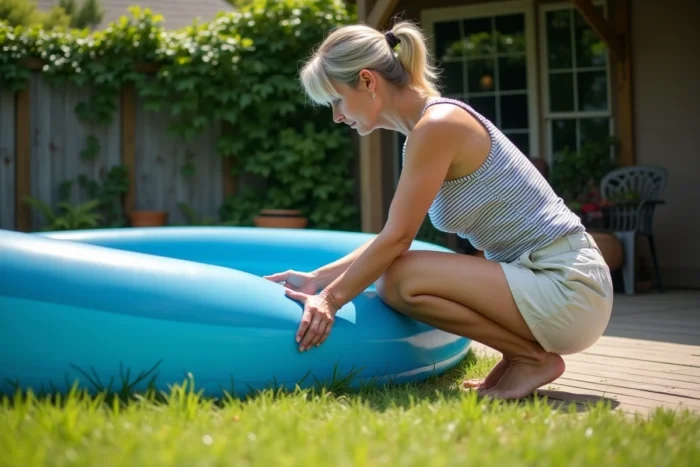
The top ring is well inflated, the filling took two hours, and yet the inflatable pool is already leaning to one side. This scenario occurs every summer in French gardens, often from the very first days of use. The problem almost never comes from the pool itself, but from what happens underneath the liner, even before turning on the faucet.
Soil Diagnosis Before Filling: The Check Everyone Neglects
Have you ever placed your pool directly on the lawn without any preparation? This is the number one cause of sinking. The grass hides the irregularities of the ground, and the mass of water amplifies every dip by a few millimeters into a visible imbalance.
Before unfolding the pool, lay a mason’s rule or a long batten across the intended area. A slight level difference is enough to make the structure tilt once filled. Rotate the rule in several directions to cover the entire surface.
If the ground has a slope, even a gentle one, there are two options: excavate the higher side to level it, or fill the lower side with compacted sand. The sand must be tamped down with a tamper (a flat compacting tool) and not just spread with a shovel. Loose sand shifts under the weight of the water and reproduces the problem in a few days.
A point often overlooked: the ground must be checked after each wintering. Freezing, roots, and runoff change the leveling from one season to the next. Checking again in spring prevents having to empty the pool in the middle of summer to correct the issue.
To go further in the method, it is useful to know how to straighten a sinking inflatable pool step by step, especially when the pool is already partially filled.
Ground Mat and Wedge: Protecting the Liner Without Creating New Imbalances
The ground mat sold with the pool (or purchased separately) has two functions: to protect the liner from stones and to distribute the load. Placing the pool without a mat on a hard or gravelly surface accelerates wear on the bottom and promotes micro-perforations that ultimately deform the structure due to asymmetric water loss.
Choosing the Right Material Under the Pool
Interlocking EVA foam tiles are popular, but they have a flaw: they compress unevenly under heavy load. On ground that is not perfectly flat, EVA tiles can amplify the imbalance instead of correcting it.
A thick geotextile felt, laid on a layer of compacted sand, offers a more stable result. The geotextile prevents the sand from migrating laterally and the liner from rubbing against the grains.
Wedge Without Destabilizing
Sliding a wedge under one side of the pool to compensate for sinking seems logical. In practice, a rigid wedge (board, concrete block) creates a concentrated pressure point that deforms the bottom of the liner and shifts the problem elsewhere.
- Prefer a correction across the entire width of the sunk side, using sand or compacted soil, rather than a single object.
- Never wedge a pool that is already full: the mass of water makes any manipulation dangerous and risks tearing the liner at the stress point.
- If the pool contains only a small amount of water (less than a quarter of its capacity), it is still possible to manually shift it to reposition the base.
Inflating the Ring and Water Distribution: Two Related Adjustments
The top ring of an inflatable pool does not only serve to give shape to the pool. It is the ring that holds the vertical walls during filling. An under-inflated ring allows the PVC to bend inward, creating a low point where water accumulates asymmetrically.
Inflate the ring to its nominal pressure (indicated in the manual), without over-inflating. A ring that is too tight in cool weather will expand in full sunlight and may burst or deform the upper lip.
Gradual Filling to Guide the Shape
Filling the pool all at once while leaving the hose unattended is tempting. The problem: the folds of the liner freeze under the weight of the water and prevent the pool from taking a regular shape.
- Fill the first ten centimeters, then pull the liner outward all around to eliminate the folds at the bottom.
- Add water in stages (a quarter of the height at a time) checking at each step that the ring floats evenly.
- Adjust the position of the pool as long as the level remains low: beyond halfway through filling, correcting an offset becomes nearly impossible without partial draining.
Inflatable Pool Sinking Despite Flat Ground: Less Obvious Leads
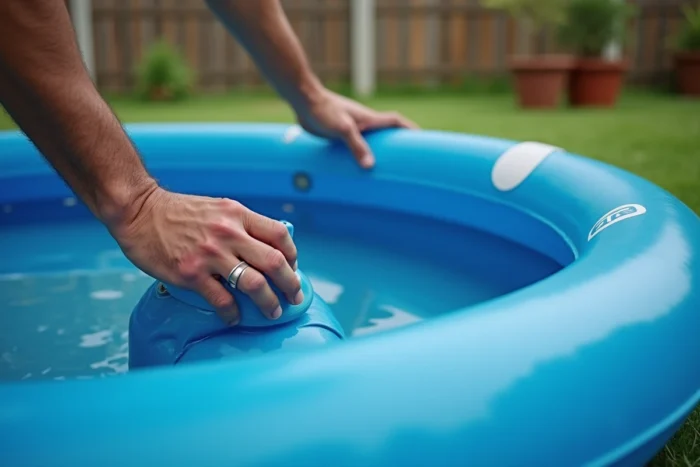
When the ground is properly prepared and the pool still leans, the problem often comes from the pool itself. A slow leak, even minimal, empties one side faster than the other. Run a sponge along the seams and around the inflation valve to detect bubbles.
A leak at the filtration connection is the most common cause of asymmetric sinking on Intex and Bestway models. The O-ring of the inlet or outlet nozzle degrades in one season if not coated with petroleum jelly during assembly.
Another lead: sun exposure. One side of the pool exposed to full south all day softens the PVC more than the shaded side. This difference in rigidity causes progressive deformation. Orienting the pool to balance sunlight exposure, or placing a parasol on the most exposed side, limits this phenomenon.
For those who replace their inflatable pool almost every year, Drop-stitch structure models are worth a look. This technology, which uses thousands of threads stretched between two layers of PVC, produces inflatable but rigid walls. The risk of sinking is significantly reduced compared to traditional soft-ring inflatable pools.
Properly preparing the ground remains the best assurance against sinking, regardless of the model chosen. A pool placed on a flat, compacted, and protected surface retains its shape all summer without intervention. Everything else, wedges, patches, reinflation, only compensates for an initial installation that was too rushed.