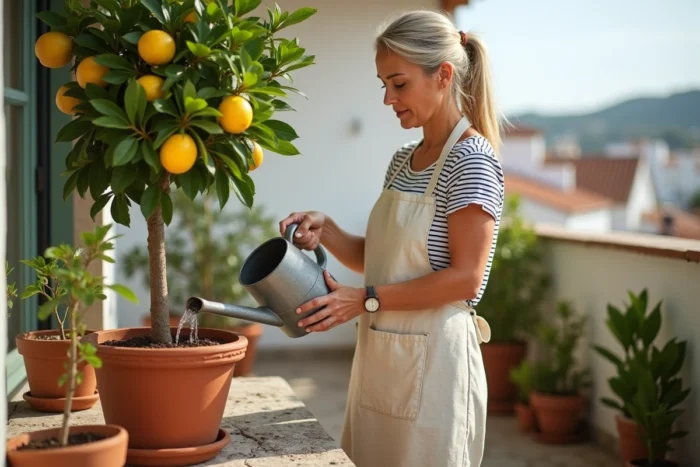
A potted lemon tree placed on a south-facing terrace in July often follows the same scenario: the substrate becomes scorching to the touch in the early afternoon, the small green fruits drop one by one, and we end up drowning the plant thinking we are doing the right thing. The problem doesn’t always stem from the watering itself, but from what happens around the pot.
Scorching substrate in summer: protect the pot before thinking about watering
When the outside temperature exceeds 35 °C, a pot exposed to full sun accumulates heat much faster than soil in the ground. The roots of the lemon tree literally cook, and no amount of water compensates for this thermal stress. No matter how much we water morning and evening, if the container itself overheats, the plant continues to suffer.
The first action to take is to elevate the pot to isolate it from the scorching ground. A paved area, a concrete terrace, or a tiled balcony radiates heat from below. Wooden wedges, a wheeled stand, or even simple bricks are enough to create a ventilated air gap between the bottom of the pot and the hot surface.
Next, you can wrap the container in a jute cloth or a light fabric to limit direct heating from the walls. A black plastic pot is the worst choice in extreme heat. If it cannot be changed, wrapping it significantly reduces the temperature rise of the substrate.
Another often overlooked point: add light shading during the hottest hours, between noon and around 4 PM. A shade cloth, an umbrella, or simply moving the pot under a tree with light foliage protects the leaves without depriving the plant of light for the rest of the day. Mastering the care and watering of the potted lemon tree starts with managing the thermal conditions of the container, even before touching the watering can.
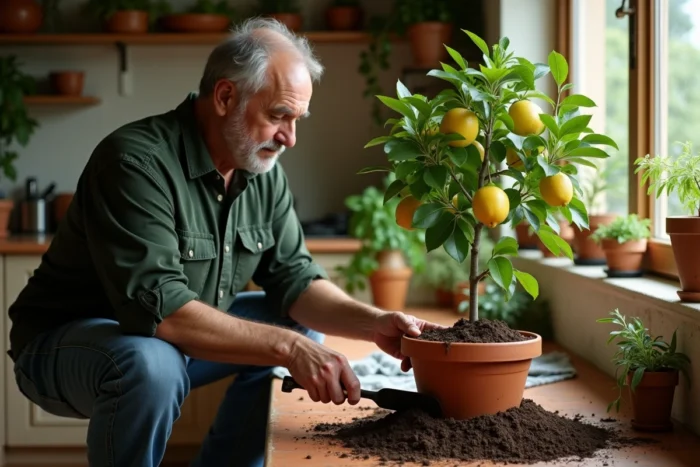
Watering the potted lemon tree: manage by the root ball, not by the calendar
Classic advice gives fixed frequencies: every two days in summer, once a week in winter. We follow this to the letter, and end up with either a waterlogged substrate or a completely dry root ball in the center while the surface seems moist.
Water when the first few centimeters of the potting mix are dry, that’s the only reliable indicator. Insert a finger three to four centimeters deep. If it’s dry, we water. If it’s still moist, we wait. This method replaces all fixed schedules, because a lemon tree on a shaded balcony in Lille and a lemon tree in full sun in Montpellier have very different needs.
The most common mistakes
- Watering a little every day instead of generously and less frequently: the lemon tree needs water to penetrate the entire root ball to reach the deep roots. Daily superficial watering only moistens the top few centimeters.
- Letting water stagnate in the saucer for more than half an hour: citrus roots quickly rot in saturated conditions. We systematically empty the excess.
- Using ice-cold water in the middle of summer: the temperature difference between the warm substrate and cold water stresses the roots. We prefer room temperature water, stored outside for a few hours.
Proper watering of a potted lemon tree involves a large volume of water flowing through the drainage holes, followed by a complete drying period before the next watering.
Potting soil, drainage, and fertilizer: the trio that conditions everything else
You can have the best watering rhythm in the world, but if the substrate is unsuitable, water stagnates or drains away without nourishing the roots. The choice of potting soil and drainage is as crucial as the watering frequency.
A well-draining substrate for citrus combines rich potting soil, a bit of coarse sand, and possibly perlite. We avoid using universal potting soil alone, which is too compact, retains water on the surface, and prevents air from circulating around the roots.
At the bottom of the pot, a layer of clay balls or gravel ensures that water never stagnates in direct contact with the roots. The pot must have drainage holes. A decorative pot without a hole is a humidity trap.
Feed without burning
The lemon tree is a hungry plant that produces leaves, flowers, and fruits almost continuously. Without regular applications of special citrus fertilizer during the growing season (from spring to autumn), fruiting quickly depletes. We follow the dosage indicated by the manufacturer, no more. An excess of fertilizer burns the roots just as surely as a lack of water.
In winter, we stop fertilization. The plant slows down, its needs decrease, and applying fertilizer during this time would force fragile growth.
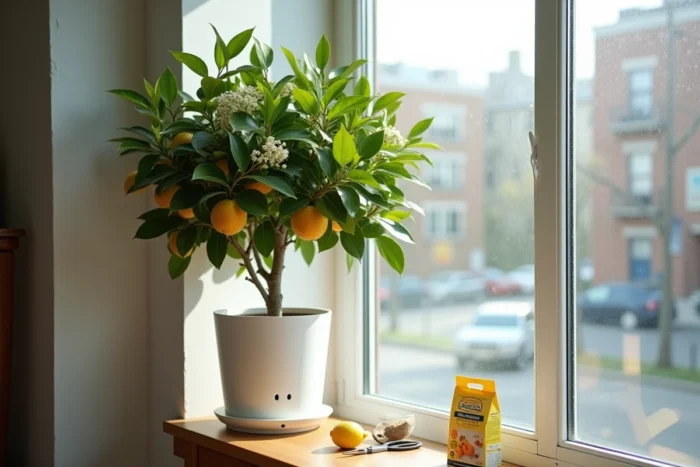
Potted lemon tree in winter: cold, light, and reduced watering
The lemon tree does not tolerate prolonged negative temperatures. As soon as the thermometer drops below 5 °C at night, we bring the pot into a bright and cool location: an unheated veranda, a garage with a window, or a room maintained around 8 to 12 °C. A lemon tree wintered in a living room heated to 20 °C weakens, because the air is too dry and natural light is insufficient.
Watering in winter is significantly reduced. We apply the same finger method in the substrate, but the intervals naturally lengthen. Every two to three weeks is often sufficient; feedback on this point varies depending on the humidity of the wintering location.
A few points of vigilance for this period:
- Watch for the appearance of scale insects and spider mites, common in dry and confined atmospheres.
- Rotate the pot a quarter turn each week so that the foliage receives light evenly.
- Do not prune in winter: we wait until the end of the frosts in spring to remove dead wood and thin out the branches.
When spring returns, we gradually take the lemon tree outside. A few days in partial shade before placing it back in direct sunlight prevent sunburn on the leaves, which manifests as brown spots on the foliage.
A well-managed potted lemon tree in terms of thermal conditions, watered as needed rather than by calendar, regularly fed, and protected from frost will produce fruit for years. The container and its environment matter as much as the plant itself: this is often where the difference lies between a tree that languishes and a tree that bears fruit.