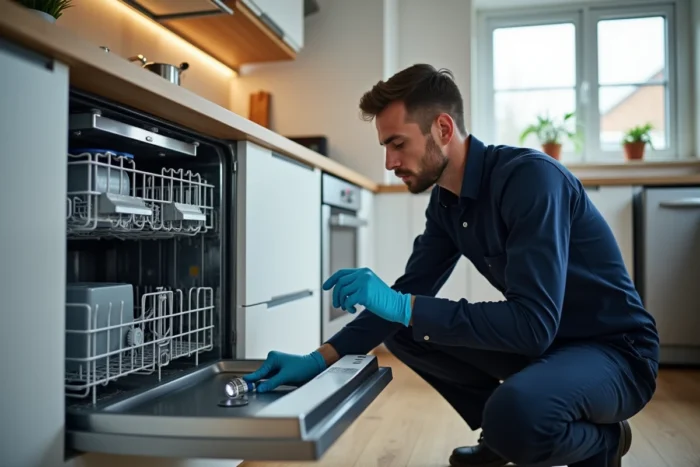
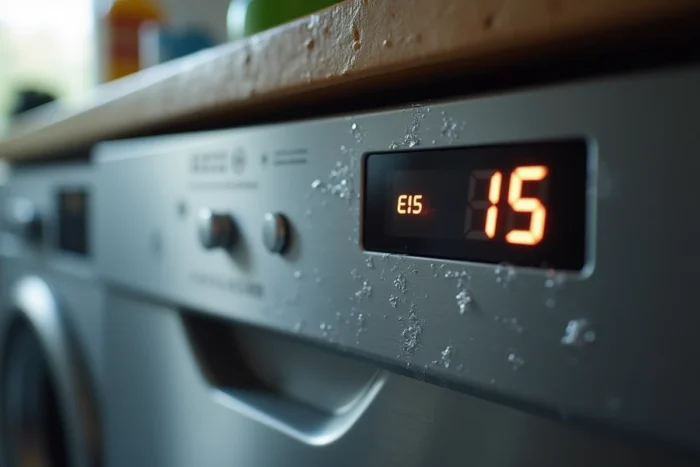
The error code E15 on a Bosch dishwasher indicates the presence of water in the base of the appliance, which activates the anti-leak device. Several recent technical guides classify this code among critical errors, on par with heating or electronic board failures. Understanding what triggers this alert, identifying the source of the leak, and knowing when a simple manipulation is not enough: this is what this article measures, step by step.
Severity of the E15 code compared to other common Bosch errors
Not all error codes on a Bosch dishwasher are equal. Some can be resolved with a simple reset, while others require immediate shutdown and thorough diagnosis. The table below positions the E15 in relation to the most common failures.
| Error Code | Meaning | Severity Level | Recommended Action |
|---|---|---|---|
| E15 | Water detected in the base (anti-leak activated) | Critical | Immediate shutdown, inspect the base |
| E09 | Heating element failure | Critical | Replace the heating element |
| E24/E25 | Drainage issue or clogged pump | Moderate | Clean filter and drain hose |
| E22 | Clogged filter | Low | Clean the filter |
The classification of E15 as critical is based on a simple observation: clearing the code without addressing the leak almost always causes it to return in the next cycle. Restarting a program without checking is akin to masking an active symptom.
To better understand the E15 error code on a Bosch dishwasher, you must first precisely locate where the water is coming from before attempting any repairs.
Locating the leak in the base of the Bosch dishwasher
The Aquastop system equips the vast majority of Bosch dishwashers. When water reaches the retention basin located under the tub, a polystyrene float rises and cuts off the water supply. The E15 code then appears on the control panel.
The challenge is that the water in the base can come from very different sources. Here are the areas to inspect as a priority:
- The door seal: a worn, deformed, or detergent-laden seal allows water to pass to the bottom of the machine. Run your finger along the seal to detect cracks or hard deposits.
- The connections of the water inlet hose: check the tightness at the faucet and at the appliance’s entry point. A connection loosened by a few millimeters is enough to create a slow leak that accumulates in the base.
- The drain pump and its hoses: the clamps on the internal hoses can loosen over time. A leak at this level is often invisible without removing the lower kick plate.
- The softener tank: on some models, a cracked or poorly sealed salt reservoir releases salt-laden water, which accelerates the corrosion of nearby parts.
Before handling anything, unplug the appliance and turn off the water supply. Then remove the kick plate to access the base and visually identify any signs of moisture or limescale deposits that reveal the source of the leak.
Draining the base and resetting the anti-leak sensor
Once the source of the leak has been identified and corrected (seal replaced, connection tightened, hose repaired), the next step is to drain the stagnant water in the retention basin. This is a step that many tutorials oversimplify by recommending only tilting the appliance.
Tipping the machine to drain residual water
Place thick towels on the floor. Tilt the dishwasher forward at about 45 degrees so that the water flows out from the front of the base. Hold this position for a few seconds, then straighten the appliance. Repeat the operation if necessary.
Simply tilting does not resolve anything if the leak has not been addressed beforehand. This is a point that recent technical guides emphasize: tilting empties the basin but does not eliminate the cause. Without prior inspection of the base and seals, the code will return in the next cycle.
Resetting the dishwasher after draining
Once the base is emptied and the machine is upright, plug the appliance back in and open the water supply. On most Bosch models, hold down the start button for a few seconds to initiate a reset. The E15 code should disappear if the float of the Aquastop sensor has dropped.
If the code persists after this procedure, two hypotheses arise: either water remains trapped in a corner of the base, or the anti-leak sensor itself is faulty (float stuck in the high position, oxidized contact).
When the E15 code persists despite draining the base
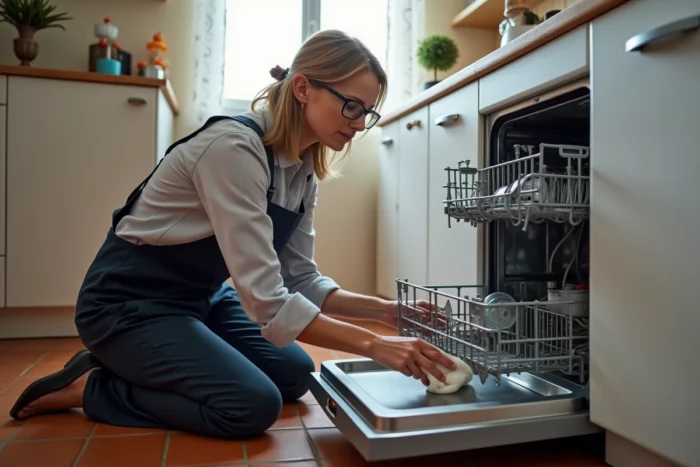
A stubborn E15 often points to a problem that tilting cannot resolve. The drain pump then deserves particular attention.
Check that the drain pump spins freely by manually rotating it (appliance unplugged). A foreign object stuck in the impeller, a shard of glass, or an olive pit is enough to block rotation and cause water to back up into the base.
On recent Bosch models, the service mode displays four-digit codes that are more detailed than the simple E15. Accessing this mode requires a specific key combination for each series, documented in the technical manual. These additional codes help distinguish a sensor problem from a pump or valve issue, preventing unnecessary part replacements.
If the pump is working, the base is dry, and the code returns nonetheless, the Aquastop sensor or the electronic board is likely at fault. At this stage, calling a qualified technician avoids risky manipulations on electronic components under warranty or out of warranty.
The E15 code remains one of the most reliable signals that a Bosch dishwasher can emit: it protects the appliance and the home from water damage. Treating it as a simple alert to reset is to ignore an active leak that will eventually damage the floor or the internal components of the machine.