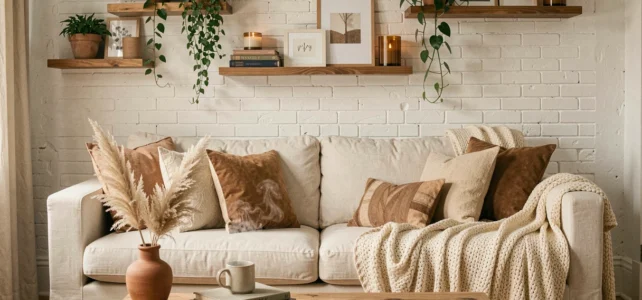
A house where you feel good doesn’t depend on a decor budget. It relies on a few concrete choices regarding light, materials, and room layout. Transforming your home into a cocoon starts with understanding what creates a sense of comfort, then acting on those levers without having to redo everything.
Indoor air quality and thermal comfort: the invisible foundation of the cocoon
Before discussing cushions or candles, a true cocoon begins with what you can’t see. The air you breathe and the perceived temperature affect your well-being far more than a wool blanket.
Indoor air is two to five times more polluted than outdoor air if the home is poorly ventilated. Fine dust, volatile organic compounds emitted by new furniture, stagnant humidity: these factors degrade sleep and daily energy. Check that your ventilation system is working, clean the extraction vents, and air out each room for at least ten minutes a day, even in winter.
Thermal comfort, on the other hand, is not just about heating. A room at a good temperature but with cold walls gives an unpleasant sensation. If your exterior walls feel icy to the touch, the insulation needs to be reassessed. An energy performance diagnosis (DPE) can help you understand your situation. Homes rated E, F, or G continuously lose heat, making any attempt at decorative cocooning rather futile.
To explore these topics related to home design and well-being, you can access the Declic Web site, which gathers resources on housing.
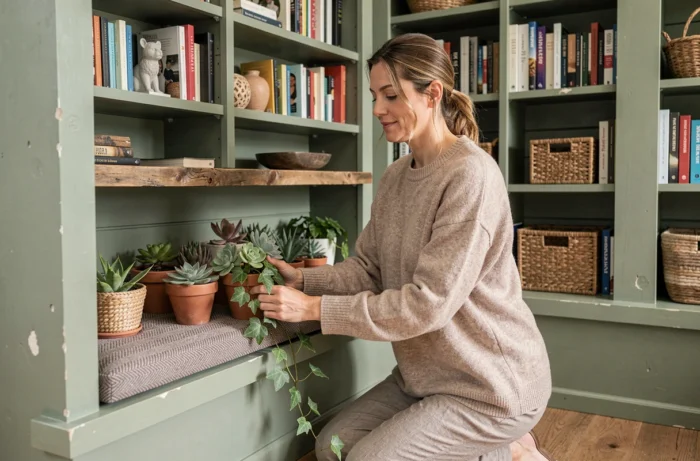
Light and colors: creating a cocooning atmosphere room by room
You may have noticed that some rooms instantly calm you, while others feel cold or impersonal? The difference often comes from the lighting and color palette.
Warm and multiple lighting
A single ceiling light produces flat lighting. For a cocooning atmosphere, multiply light sources at eye level: table lamp, reading light near the sofa, discreet string lights on a shelf. Prefer bulbs with a color temperature below 3,000 kelvins. This golden light mimics the end of the day and naturally triggers relaxation.
In the living room, place at least three distinct light points. In the bedroom, banish the ceiling light in favor of bedside lamps and a soft nightlight. The bathroom benefits from having a dimmer switch for the evening.
Soothing color palette
Neutral and earthy tones transform the atmosphere of a room without heavy renovations. Beige, terracotta, sage green, warm gray: these shades work in any interior style. A single wall painted in an enveloping tone is enough to change the perception of an entire space.
Keep bright colors for accessories (cushion, vase, frame). This balance allows you to change the ambiance with the seasons without repainting everything.
Natural materials and textiles: the comfort you can touch
The cocoon is also experienced with hands and feet. Smooth synthetic materials convey a cold sensation. In contrast, wood, linen, wool, and washed cotton provide immediate tactile warmth.
- Raw or lightly oiled wood on a piece of furniture, a tray, or a photo frame visually anchors the room and warms the overall decor.
- A rug made of natural fibers (jute, sisal, wool) placed under the coffee table or at the foot of the bed radically changes the comfort of a room with a hard floor.
- Throws and cushions in textured materials (chunky knit, crumpled linen, faux fur) create visual layers that invite you to settle in.
Layering multiple textures in the same space creates an enveloping effect. For example, combine a vintage fabric sofa, a chunky knit throw, and corduroy cushions. Three different materials are enough for the eye to perceive richness without overload.
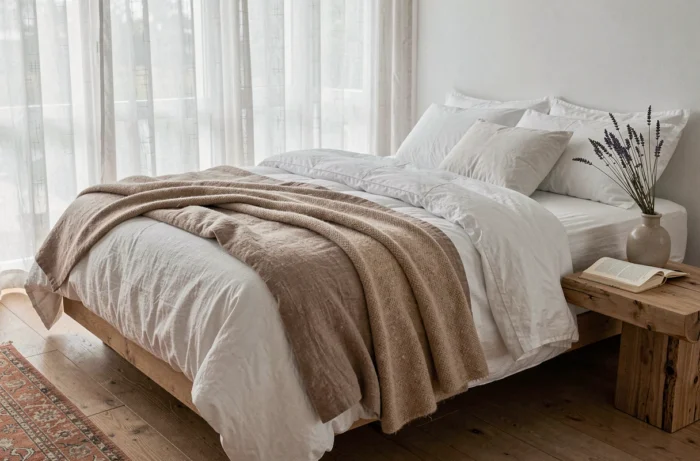
Adapting your interior for aging: the sustainable cocoon
A cocoon that no longer works when you have back pain or difficulty bending down is not really a cocoon. According to the report from the High Council for Family, Childhood and Aging (HCFEA) adopted on February 20, 2024, 96% of people aged 60 and over live in ordinary housing, and this rate remains at 90% after age 75. However, only 6% of homes are adapted for aging.
This gap creates a concrete risk. A bathroom with a high bathtub edge, a cluttered hallway, or insufficient lighting at night become sources of falls. Thinking about accessibility now protects your future comfort, even if you are thirty years old.
Some simple actions can improve the situation:
- Install grab bars in the shower and near the toilet, even discreet and stylish ones.
- Replace a bathtub with a walk-in shower, which is also more aesthetic and easier to clean.
- Plan for automatic detection lighting in hallways and the entrance.
- Avoid unsecured rugs, the leading cause of household tripping.
The DREES barometer published on September 16, 2025, indicates that 74% of French people do not wish to live in an institution in case of loss of autonomy. Adapting your home also ensures that it will remain a true cocoon over time, not just during the years when you are perfectly mobile.
Ultimately, transforming your house into a cocoon comes down to a simple principle: address what is felt before what is seen. Healthy air, uniform temperature, soft light, and pleasant materials to the touch form a solid foundation. Decoration then comes to dress this whole, not replace it.