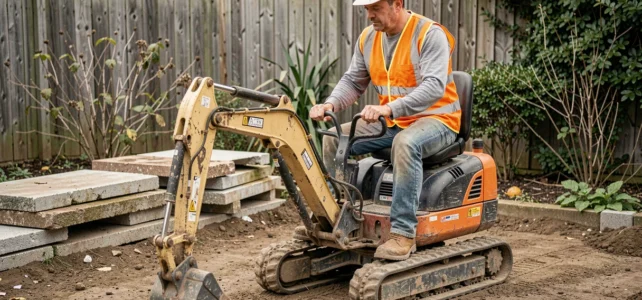
Excavating a terrace is not just about digging a few centimeters of soil. The choice of machine, the type of soil, and access constraints to the site determine both the duration of the work and the quality of the final result. Before renting the first available machine, several technical parameters need to be evaluated to avoid a project that gets bogged down, both literally and figuratively.
Site Access and Machine Size: The Underestimated Factor
Most guides on excavation directly point to the choice between manual labor and a mini-excavator, without first asking: can the machine access the work area? A standard garden gate, a driveway bordered by walls, or a passage between the house and the fence significantly reduce options.
For residential projects, a mini-excavator weighing 1.5 to 2.5 tons covers most terrace excavation needs. More compact models, around 800 kg, now exist to fit through narrow openings, including standard garden gates. Their digging capacity remains sufficient for shallow excavation, but their limited power imposes conditions: soft to moderately compact soil, reduced depth.
Before any rental, measure the width of the narrowest passage between the access road and the future terrace. Compare this measurement to the overall width of the intended machine, including tracks. A difference of a few centimeters can turn a workday into a logistical dead end. The excavation of a terrace with a machine suited to the terrain’s dimensions remains the primary criterion for success, far ahead of the machine’s raw power.
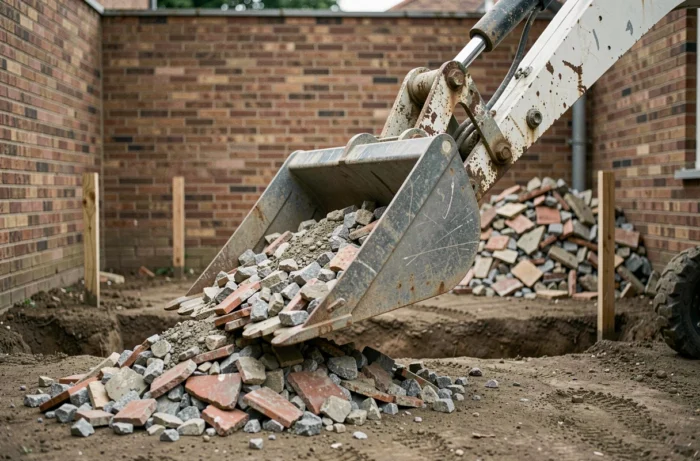
Clay Soil and Excavation: Why Technique Changes Everything
The type of soil radically alters the progress of the project. Sandy or loamy ground can be excavated without particular difficulty. Clay soil, on the other hand, requires a different approach.
On dry clay, the soil becomes extremely hard. The mini-excavator must work in small successive passes, without forcing laterally on the bucket, or risk prematurely wearing out the teeth and straining the cylinder. In this case, a heavier machine may be justified to maintain an acceptable work pace.
On wet clay, the problem reverses: the soil sticks to the bucket, accumulates on the tracks, and turns the site into an ice rink. Field reports vary on this point, but several practitioners recommend waiting for a dry spell before intervening, even if it means delaying the project by a few days.
- Dry clay: short passes, narrow bucket, high digging pressure. Expect a longer working time than on standard soil.
- Wet clay: risk of track slippage and bucket clogging. Postpone the project if possible or plan for access plates.
- Mixed soil (clay and stones): stones partially protect the bucket but complicate final leveling. Manual sorting is often necessary after the machine passes.
Excavation Depth and Bucket Choice for a Terrace
The depth to be excavated depends on the planned covering. For a terrace on pedestals, the goal is generally a depth sufficient to accommodate the draining gravel bed, the geotextile, and the pedestals themselves. For a concrete slab, the depth increases to include the gravel layer and the slab.
The standard excavation bucket is suitable for most terrace excavations. Its width determines the number of passes needed to cover the area. A wider bucket speeds up work on soft soil but becomes a hindrance on hard soil where penetration resistance increases proportionally with width.
For shallow excavation (about ten centimeters), a cleaning bucket, which is wider and without teeth, allows for more even work and a flatter base. The choice between an excavation bucket and a cleaning bucket therefore directly depends on the desired depth and the expected finish.
Checking Flatness During Excavation
Working at the correct depth across the entire surface requires reference points. Drive stakes at the four corners of the future terrace and connect them with taut strings at the reference height. Regularly measure the distance between the string and the bottom of the excavation during work.
A common mistake is to rely solely on visual judgment. On a surface of several square meters, a two-centimeter discrepancy goes unnoticed but compromises the installation of the covering, especially on adjustable pedestals where the adjustment range is limited.
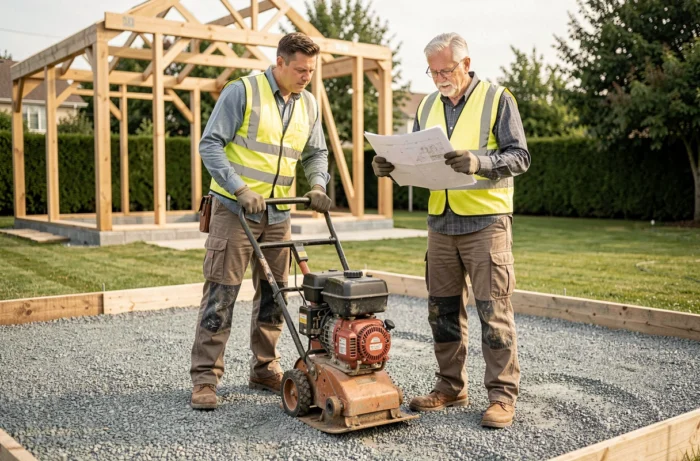
Administrative Obligations Before Excavating Land
The regulatory framework surrounding excavation is more stringent than most tutorials suggest. For any project near buried networks (water, gas, electricity, telecommunications), a work declaration of the DICT or DT-DICT type is mandatory. This process allows you to obtain network plans and avoid serious accidents.
Furthermore, operating a mini-excavator falls under category A of construction machinery. In theory, an individual renting a mini-excavator for personal use is not subject to the same obligations as a professional. In practice, the rental company may require proof of competence or an AIPR (authorization for intervention near networks), especially if the project is located in a dense urban area.
Check with the rental company and your town hall before starting. Some local urban plans impose constraints on altering the ground level, even on private property, as soon as the excavation exceeds a certain extent.
Soil Removal: The Item That Is Often Underestimated in Budgeting
The volume of soil extracted from a terrace excavation almost always surprises. Once the soil is removed from its compact state, it occupies a volume greater than that of the hole dug. This phenomenon, known as swelling, significantly increases the volume to be removed compared to the theoretical volume calculated.
Planning for soil removal before starting excavation prevents ending up with an immovable pile of soil in the middle of the garden. There are two main options: renting a skip along with removal by a service provider, or reusing it on-site if the terrain allows (backfilling a low area, creating raised beds).
The cost of removal often represents a comparable portion to that of renting the mini-excavator itself. Ignoring it skews the overall project estimate and turns a controlled project into a source of unforeseen expenses.